

Body Safety / Talking Sex, Early Years, Babies & Toddlers, Newsletter Articles, Posts for Parents
Some important, awkward conversations that we need to have in our homes

Updated June 2026
In short …
- Rather than saying ‘stranger danger’ to your kids, the experts in protective behaviours prefer you to call them ‘tricky’ people.
- The influence of pornography has increased the intensity and level of disgusting language aimed at our girls and female teachers.
- We need to teach our children from childhood, that their body belongs to them – their private parts are meant to be private.
- Children do not choose to behave badly, they are simply struggling to make better choices in the heat of the moment.
- Warm discipline, approaching discussion with genuine affection, is far more effective than punishing our children for making poor choices.
Parents are our children’s first teachers and there are many conversations that they can have with their children, that help them make better choices or just be safer. Even if your school does run protective behaviours programs or cyber safety programs it is parents’ continuous conversations that really give our kids the rails on the bridge, to guide them in their choices and decision-making over the years. We are not always beside our children, so ensuring that they can make good decisions when we are not there is incredibly important.
Here are just a few of those awkward conversations that really matter.
1. Identifying ‘tricky’ behaviours of unsafe people
At the time I am writing this, there is news of a girl who was abducted in Perth on her way to school. Even though this is every parent’s worst nightmare, it is extremely rare. In this case, an observant parent noticed the girl getting into a car and, feeling it was suspicious, contacted the police. We can all be vigilant observers of our children and trust our instincts if something doesn’t feel right. Fortunately, the girl was recovered in a nearby shopping centre and the perpetrator was arrested.
We need to have conversations with our children around the possibility that some evil humans may behave this way. Given that over 90% of the people who harm our children are people that they know, rather than only talking to our kids about ‘stranger danger’ the experts in protective behaviours prefer you to call them ‘tricky’ people. They suggest that you explain to your children that if a tricky person approaches them, especially requesting your child go with them, they may use one of several ways of coercion. They may tell the child that they have a puppy or a kitten in the car, or that they have lollies or treats, or they may say that your mum has asked them to pick you up. This way we give them real scenarios so that they may realise this is a tricky person.
The second part of this conversation which is recommended is to ask a child to check in with their early warning system. Does it feel right on the inside? Or does something feel off? I have a list of resources on my website that can help to teach kids how to tune into this (and also teach other protective behaviours).
The third suggestion is for you to have a code word, that is only given to those people that the family trusts. So if somebody says their parents sent them to pick your child up as there was an emergency, they ask for the codeword. If they realise this person is an unsafe person, the experts suggest children run to someone they know, or the lollipop person at a crossing, or the owner of a nearby shop or a parent with a pram.
A final suggestion is that children who walk to school, do so with other children or grown-ups.
2. Your expectations around disrespectful behaviour and harassment
In both my bestselling books about raising boys, I have explored the role of physicality, banter, teasing and using humour among boys. I explore the concept of a line in the sand where these things cross from being appropriate and acceptable, to being harmful and hurtful.
I have been getting messages from worried teachers and parents, about boys barking at girls. This is demeaning behaviour in the same way that using sexual groaning and making inappropriate gestures and sexist name-calling is. Our girls are being called sluts and hoes. Sadly, the influence of pornography has increased the intensity and the level of disgusting language that is being aimed at our girls and our female teachers. If you have boys from primary to high school, please have a conversation with them about your expectations if they or their mates are behaving this way. Explain to them that it is not funny and that if they are caught they can be charged with a criminal offence as it is a form of sexual harassment. Suggest they stand up and call this behaviour out as being disrespectful and wrong. There is only so much our schools can do to stop this behaviour, and the best way to stop it is a collective approach with parents and community members also speaking up.
3. Teaching children body safety and consent
Another awkward conversation that comes from the protective behaviours experts, is the one around our physical bodies. We need to teach our children from childhood, that their body belongs to them. Their private parts are meant to be private. There has been a significant increase in inappropriate sexual play with children under five, due to the ease of access to pornography. Please teach your children no one is allowed to touch their private parts without their consent. Sending nudes via smartphones has become quite common.
I have read reports where teen girls often feel pressured by boys to send nudes. Sadly, sexual predators who are pretending to be children or teenagers are also out there, grooming our kids online, to send explicit images. Sextortion has escalated in the last few years. This is where children (of any gender) have been groomed to send images, and are being threatened that these images will be shared with all their loved ones or online, if they don’t pay money. Over 90% of the victims of sextortion are young males, predominantly between 15 and 17 but as young as 10. Please have serious conversations about the taking and sending of explicit images. Tell your children that sending them or receiving them is illegal and is a criminal offence. If they are caught with such an image on their phone, they can be charged by the police, and put on the sex offenders register for life. When you have this conversation, reassure your children that they can always come to you when they are sent these images, or they are being requested for these images so that you can take the appropriate action to keep them safe. Please check out the E-Safety Commissioner website for excellent information that is up-to-date.
You might also want to listen to my Parental As Anything podcast interview with Cath Hakanson, in which we talk about sex, relationships, consent, pleasure, bodies and porn.
4. The three rules that matter
We are a social species which means we are biologically wired to need to belong in systems, like families, neighbourhoods, communities and in a wider context countries. Getting along with others is really important for our emotional, social and mental well-being. When our children are under five, they are learning many of the things that will help them behave in ways that are not hurtful or disrespectful. One of my key messages for parents has been the three rules.
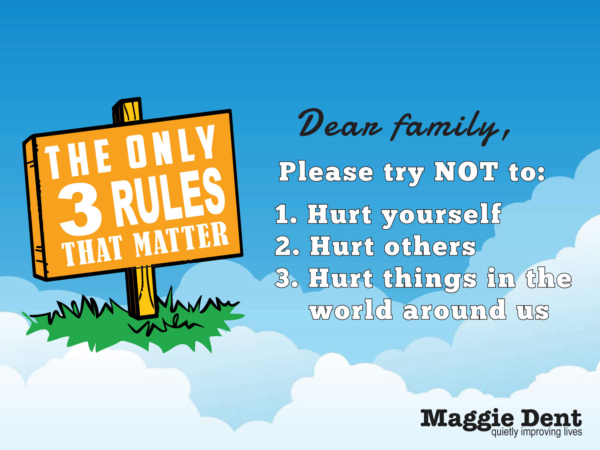
From as early as possible we remind our children to try not to hurt themselves, others or the world around them. Sometimes with toddlers, they take quite some time to learn that biting is not okay, that pushing other children over is not okay, and that taking other children’s toys is not okay.
You will need to have these awkward and tough conversations many, many times as your children grow.
Often our children’s impulsive, difficult behaviour is driven not by choice, but by their body’s response to stress. When a child is not coping with their environment, for whatever reason, they are unable to access their prefrontal lobe, to make good choices. Dysregulation, when their bodies are flooded with the stress hormone cortisol, feels awful for anyone – whether it’s your 2-year-old toddler, your 8-year-old feisty rooster, or your confused, angry 14-year-old. When they are in this storm, it is so important that you don’t join them.
They are not choosing to behave badly, they are simply struggling to make better choices in the heat of the moment.
Before you have an awkward conversation after such a moment, remember the glitter jar metaphor. Pause until the glitter has settled before you approach your child to explore what may have triggered the big meltdown. Then explore together how to navigate that tough moment differently next time.
5. Preparing your children to access the digital world
Our children are digital natives. The screen world has swamped childhood, and despite the advantages it has brought, it has given our children access to images and information, that no child should ever see and made them more vulnerable to exploitation, bullying, exposure to gambling, pornography and more. It is the most significant challenge for parents today, navigating this world that is forever changing. Claire Orange from DiGii Social uses the metaphor of a busy highway when talking about preparing your children to access the digital world. We don’t put our toddlers in the middle of a 10-lane highway where cars drive at 110kph. We gradually prepare them over time, so that they can learn to drive slowly, in the 60 K zone.
Children are constantly learning habits thanks to the gift of neuroplasticity, and it is parents’ responsibility to teach them how to be respectful, responsible digital citizens. Consider carefully the age at which you give your child a smartphone. Rebecca Sparrow has given many other options. In 2026, my friend and colleague the Unplugged Psychologist Dr Brad Marshall announced his involvement in the design of a screen-free phone called the Chatterbox by Waffle. Brad also has some great books on better managing tech use in your home. You may also want to check out this episode of Parental As Anything on what you need to know before you give your child a smartphone.
Once your kids or teens are ready for a smartphone, talk about (and check) privacy settings, location settings, what kind of access to data apps have and have conversations about things like how algorithms work, AI and deep fakes. You might be surprised at how much your kids know, indeed you may learn something from them! The ABC TV series I was part of in 2025, The Role of a Lifetime, had a fantastic scene where the 11-year-old son in the series uncovers the fact that a parenting guru his mum and grandma are following is actually a fraud! If you have tweens / teens in your house I do recommend watching the show which is available to stream on ABC iView.
Parents who hold strong boundaries, not just around how much time their children are online but more importantly what they are doing online, are preparing their children to be such citizens. Having regular conversations about respectful behaviour really does make a difference. If you have boys who are using offensive language while they are gaming, there needs to be a conversation around why that is unacceptable and possibly a consequence may be necessary to discourage that behaviour. Teaching all our children to avoid any usage of hurtful language, putdowns and name-calling in the real world and online, is our job as parents. Be very specific with the words you do not want them to use, and possibly something to use in place of it. If you haven’t seen the episode of Bluey around the use of the word biscuits, it’s a goodie. To stay on top of the game, I recommend you follow the following good humans who are experts in this space.
- the online safety coalition I am part of, CTRL+SHFT
- Safe on Social
- DiGii Social
- Unplugged Psychologist
- Dr Kristy Goodwin
- Sex Ed Rescue
- eSafe Kids
- ACCCE
- PB West
Remember when you have these conversations, be curious rather than furious. These conversations can often be better taking place in the family car with one child whose behaviour you are concerned about, rather than with all the siblings present. I talk much more about this — and include actual scripts for having some of these difficult conversations with tweens and teens — in my 2024 book, Help Me Help My Teen.
Warm discipline, where we approach these things with genuine affection, is far more effective than just punishing our children for making poor choices. You are your child’s number one teacher, and it is your job to keep teaching them about life and all the stuff that happens within it. You made mistakes when you were a child and probably made many more when you were a teenager. Rather than hope that your school will cover that subject, step forward and embrace the awkward, difficult conversations with compassion, good information, parent swagger, and hopefully with a big dose of unconditional love.
Blog image credit: © by alitia/Depositphotos.com
Your guide to those tricky conversations about life online
When it comes to teaching our kids and teens how to be safe, kind, respectful digital citizens, we need to have lots of little, often awkward, chats. Maggie’s newest book, co-authored with Kirra Pendergast, has got you covered. It’s a non-judgemental guide to helping your kids be the authors of their own digital lives.
Digital Freedom is out now!
ORDER NOW