
Newsletter Articles, Posts for Parents, Schools: Choosing & Transitioning
Choosing the right first school for your child

In short …
- There is no perfect school and you know your child best, so trust your instincts when making this decision.
- Before choosing a school, focus on what you can do at home to build your kids language skills, self-efficacy and confidence.
- Talk to other parents about their experiences, and factor the friendships your child already has into your choice.
- When visiting schools, look beyond the website. The school culture, how you are greeted, the sound of children at play and the play spaces all tell you more than the promo.
- In this blog, Maggie explores some key things you can do to make the best possible choice for your child.
I am writing this blog towards the end of May in 2026 when many parents here in the southern hemisphere are making decisions about where their child will start school in the New Year. For those in the northern hemisphere, I realise these decisions are often made at a different time of year, however, this could still be helpful when the time is right for you.
Firstly, there is no perfect school for your child. The same as there is no perfect teacher, no perfect parent and definitely no perfect child. Every parent wants to make the best decision they can, so that the educational experience for their child is a positive one. There is no guarantee that if you choose the most expensive private school in your area that your child will automatically thrive. The reverse is also true, that your child can thrive in a nearby government school. In Australia, there is massive inequity in the funding from our Federal Government to our schools and to watch this continue year after year is beyond disappointing.
I am proudly a country government-school-educated individual, and my four sons did high school in the local country government high school, and all of them have achieved professional careers. For those in rural communities, often you have no choice because there is only one school. Many people choose boarding school as a result, or do remote learning.
School reluctance and school can’t numbers have risen significantly over the last five years and that is a sign that many of our kids are not finding school environments that work for them, and many of them come to thrive with homeschooling and distance education.
Schools are so much more than what is shown on their websites. They are so much more than the buildings and the promises they make.
As a former teacher, and a parent and grandparent I celebrate all hard-working teachers and school staff who are doing their best in very different environments and with very different social pressures than I faced in the last century. Yes, that’s only 26 years ago, however, so much has changed.
Two years ago, I expressed my concerns for our teachers who are struggling with today’s environment:
My heart aches for all those teachers who are leaving the profession due to the massive increase in stress. Overloaded curriculums, excessive testing, time-consuming accountability tasks, teaching out of your expertise, implementing new fads that have a questionable chance of succeeding and lack of support for challenging students often steal valuable time to prepare, to refill their cup and even to nurture healthy relationships.
I celebrate and thank every teacher who has taught
or is still teaching. You matter.
I include that quote here so that parents can appreciate, how in many ways the system is broken and despite me fighting for the last 13 years to move formalised learning back to where it was, absolutely nothing has changed.
We have more stressed and anxious children than ever before, who are less resilient and yet we are still expecting them to be able to learn content that is, for many, developmentally inappropriate .
Please do not blame the teachers as they are not the ones who determine the curriculum and the expectations of schools.
From the 2024 Australian Early Development Census, we know that almost one in four of our children are arriving into big school with significant developmental vulnerabilities. I have long been an advocate against starting formalised learning by five, because many of them are still four-year-olds when they start.
Not only that, the Longitudinal Study of Australian Children shows that there is an increased vulnerability for many boys and Indigenous children. If a child is struggling at the age of five, they are more likely to struggle for the rest of their schooling journey. My first tip for any parent considering school options is to have a really good conversation with a key early childhood educator who knows your child, and keep that in mind as you make that choice. Boys, kids born late in the year, kids who have experienced significant trauma, and many neurodivergent kids can benefit from another year at building the social and emotional skills needed to navigate the traditional school environment. Sadly, in our current economic climate, many parents do not have the financial capacity to give their children one more year.
Starting big school
I was delighted to interview Dr Kaylene Henderson on my ABC podcast, Parental As Anything about starting big school. This podcast would be a great place to start if this is what you are considering at the moment.
Before we consider which school, let’s look at what you can do as parents to help your child before they make this big transition.
- Building your child’s self-efficacy, or ability to do things for themselves, can help enormously when they move into a school environment. Dressing themselves, getting their own snacks, opening their own lunch box and drink bottle, helping with small home chores… these things might not seem important but they develop a quiet sense of competence that builds confidence that they will take with them to school.
- Next, prioritise as much play (with the potential for risk) outside in the real world with children of all ages, all genders and all neurotypes. This is how Mother Nature intended to build our children’s emotional, social, physical and cognitive capacities. The lack of gross and fine motor skills for many of today’s children is compromising their ability in the classroom. Movement as much as possible in the first five years of life will give your child a better chance at navigating the expectations of the classroom. Educators are reporting children without the core strength to be able to sit in a classroom chair without falling off!
- Marinate your children in language from human faces, not screens. We know one of the key things that is concerning teachers of five-year-olds is the lack of verbal language and vocabulary. They simply don’t have the same number of words as previous generations. So please read to them, have conversations with them, sing with them, and you will be building a key element of competence for starting big school.
School options?
For those who have the privilege of choice, do your homework or due diligence. Definitely take your child with you on a tour of the school, and have conversations with other parents whose children go to the school you are considering. If you have a highly energetic child, and for many boys that is the case, give consideration to the play area and what options they will have to move a lot during recess and lunch. Schools with engaging nature play opportunities, and which allow autonomous free play, are often far better than those with limited play opportunities.
If your child has a developmental vulnerability, ensure you explore what options are available to help your child build the accommodations and skills they may need. I have been visiting some exceptional government schools who have created wonderful environments for children with developmental exceptionalities. Some, sadly, have not created these opportunities.
If your child is a sensitive child there are some other considerations that you may need to take into account. I have written a whole blog about this.
If you need to choose between two similar schools, and your child has good friends going to one of those schools, I suggest you choose that school. Having friends, especially ones they’ve known for a while, is a significant protective factor when our little ones start big school. If this is not a possibility for you as you may have moved to an area, frequent nearby playgrounds and maybe join kids’ activities at the local library to see if you can connect with other parents who have children at the same age. Be brave to say hello and let others know that you are new to the area. Having a friend can reduce anxiety significantly for all children, however, especially for sensitive little ones.
Given that I am a boy champion, I have been concerned about the capacity for many boys at transition into big school. I have written several blogs that may be helpful if you have a little boy in that space.
Things to look for
One thing that is difficult to assess from a school website or brochure is the school culture. This actually comes from the top – the principal sets the tone for the school.
- When you visit ask yourself; how welcome did the front office feel?
- Listen for the sound of the students during break time. Is there a lot of laughter?
- Can you see a lot of play happening?
- What are the posters around the school displaying?
- What artwork can you see?
All of these things can give you a hint of the culture because some schools are driven by academic grades above all else, while others value wellbeing above grades. Some schools are still using traditional behaviourist techniques to navigate behaviour, with a major focus on punishment rather than discipline, and a tendency to still use techniques that shame children. Ask the Principal in the interview what the school’s philosophy on discipline is and how it works.
When you get to make the choice – please trust your instinct. You know your child best. Then, avoid overselling big school to your child.
Telling your kids ‘you are going to love it, it’s going to be amazing!’ can really come back to bite you. All kids take time to transition, until it feels safe and more normal. Feeling anxious and uncomfortable is totally normal and helping our children to develop small steps of bravery, is a part of growing up for all of us. This may be helpful.
Most children have some orientation trips to their new school to meet their new teacher and to explore the environment. It can be helpful from that point to mention the teacher’s name, so they can remember it on the first day.
Good-enough expectations
Another thing to keep in mind is that, much like parenting, we really are hoping that our child’s first teacher is exceptional beyond all measure! We want the beginning of their school career to be magical and amazing. It can be helpful to have a more realistic expectation that the teacher will be simply good enough!
Your teacher’s relationship with your child is key to their transition, and the more positive you are in nurturing that relationship, by being supportive, encouraging and kind, the more that will flow into the relationship in the classroom. Avoid criticism and judgement, especially online and at school drop off. If you ever have a serious concern about a teacher, take it to the teacher and possibly the principal. If you have a concern with how your child is transitioning, please make an appointment so that together you can address the concerns and overcome the challenge that you perceive.
Starting big school is a big step in a child’s life, and to be honest it’s a big moment for the child’s parents. It is normal to feel worried and anxious about this moment, and yes, there are often tears. I can still remember my boys’ first days, even though it’s almost 40 years ago!
For those of you making this decision right now, I simply send you a huge Maggie hug.
© by JenkoAtaman/ Adobe Stock
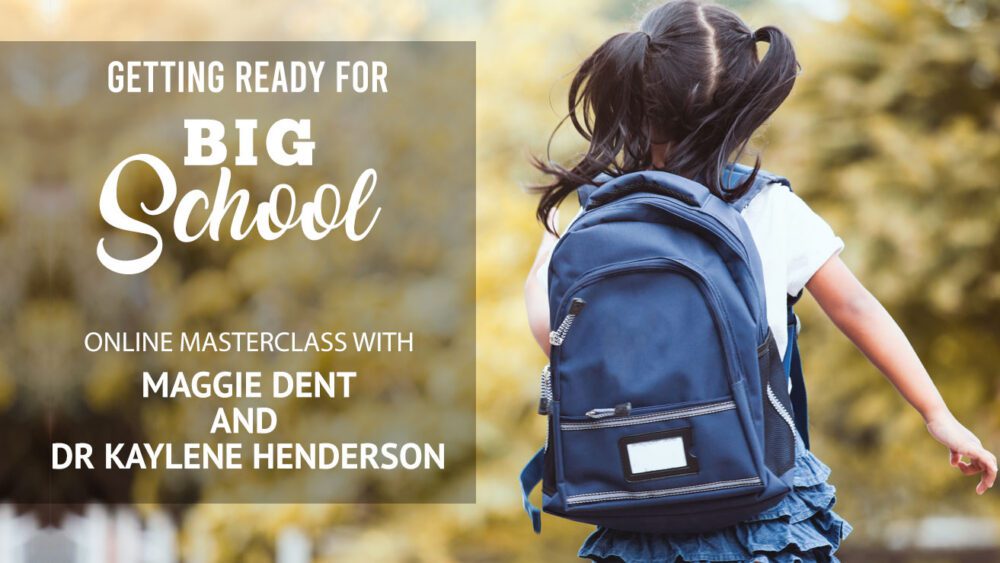
To explore more about things you can do as a parent to better help your little one transition to school, check out Maggie’s online masterclass with Dr Kaylene Henderson. Getting Ready for Big School.