

Newsletter Articles, Posts for Parents, Screen time, digital & online safety
The dark underbelly of AI that our kids need to know about
By Maggie Dent and Kirra Pendergast
In short …
- AI feels instant and magical, but the infrastructure behind it uses a huge amount of resources, which are not unlimited.
- It is our responsibility as parents to educate our children about the real impact of using AI, because it is and will continue to impact their future.
- We can take small steps to use AI more sustainably by only using it for certain tasks; and being more mindful and conservative in what we ask it to do.
- There is a lot of innovation happening in some places where data centres exist, with water and heat being re-used and recycled.
- As individuals and families, we can have agency in making choices that are less harmful than others, and advocate for responsible tech.
One thing you learn about when you work with a publisher is that your original manuscript often needs to be trimmed to keep to a recommended number of pages.
In our book, Digital Freedom, something really important ended up being cut out of the chapter about AI, and both of us are very passionate about this so we wanted to share it here.
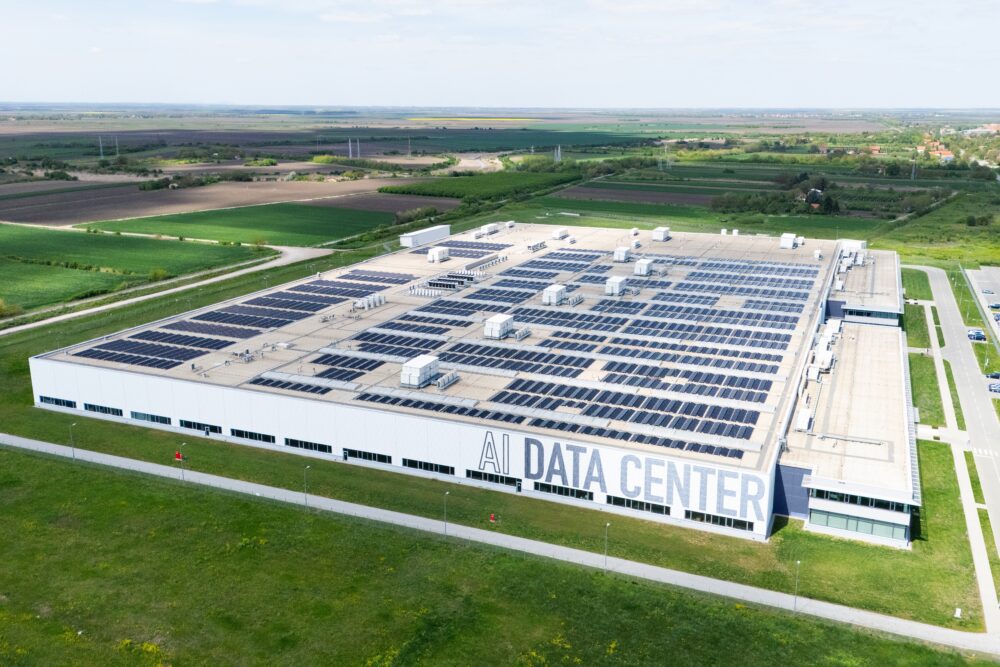
Often AI is described as living in a cloud, which gives no real context to where it does live and how it works. What Big Tech neglects to inform you is that AI lives on in other people’s computers, housed in industrial facilities called data centres.
These buildings contain thousands, sometimes hundreds of thousands, of servers. A server is a powerful computer designed to store information and perform calculations continuously, without rest. They are stacked in long rows, humming day and night, processing requests from millions of people at once.
When a child asks a chatbot a question, generates an image, or speaks to a voice assistant, nothing magical happens inside the device in their hand. The request travels through cables under streets, oceans, and borders to one of these data centres. There, banks of machines run complex calculations to predict an answer, assemble a response, or create an image, before sending the result back in seconds. Given the rapid expansion of AI the last few years, the usage has escalated and will continue to escalate.
What feels instant is actually a round-the-world journey at the speed of light.
While we can be absolutely amazed at this incredible technological feat, we need to also be aware of something else.
Those speed-of- light calculations generate heat. Enormous amounts of heat. So much heat that without constant cooling, the machines would fail within minutes. To keep servers operating, data centres rely on large-scale cooling systems, most often using water. Water is circulated through the facility to absorb heat and then released, often evaporated into the atmosphere. That’s probably why data centres are predicted to take a quarter of Sydney’s water by 2030, drive our electricity bills up over 20% and create all new demand for fossil fuels!
AI does and will continue to play a role in our children’s future. The question is whether it’ll be shaped by companies doing whatever they want, or by people who understand what it actually costs.
It’s whether children grow up believing we can take whatever we want from the planet, or that we need to think carefully about what we use. That difference doesn’t start in a data centre. It starts in the conversations we have at home about how the world works. It is our responsibility to educate our children about the real impact of these data centres and cooling towers as most are unaware of the impact on their planet.
In the survey of adolescents I conducted as part of the research for my book Help Me Help My Teen, many teens expressed their deep concern about climate change and the survival of our earth. They are already worried and so we need to prepare them with accurate information about what’s happening almost invisibly around the world to enable AI to grow exponentially.
Here’s what most people don’t know. Around the world, data centres are being built in places where land is cheap, rules are loose, and local communities have less power to say no. In regions already facing drought, climate stress, or rapid population growth, this creates immediate pressure. It is not a distant or abstract competition. It is water diverted from crops, from communities, from fragile environments, to keep machines cool enough to keep thinking.
These data centres are often being built in countries desperate for foreign investment. These communities are promised jobs and economic growth and a brighter future. The reality is usually much less. A few months of construction work. A handful of permanent jobs that local people often aren’t trained for and then a massive building that uses enormous amounts of local water, energy, and land to serve people living somewhere else.
What makes this a global issue is not simply where data centres are built, but where their impact is felt. A question asked in one country may draw on water, energy, and land in another. The benefits of AI flow outward to users everywhere. The costs, however, concentrate locally often in places with the least power to refuse them. Yes, the countries that struggle the most with poverty and poor living conditions.
This is why the way we talk about AI at home matters.
When technology feels easy and instant, we stop asking what it costs. When answers pop up immediately, we forget that even artificial intelligence runs on real resources that aren’t unlimited.
When children grow up thinking digital systems go on forever with no consequences, they learn to separate what’s convenient from what’s responsible.
And the problem doesn’t stop at water. AI systems need massive amounts of electricity to run. While some companies use renewable energy or try to offset their carbon emissions, most of the world’s electricity still comes from burning fossil fuels.
The result is a growing carbon footprint connected not to some far-off factory, but to everyday things we do online.
Asking ChatGPT for homework help. Making AI-generated images. Streaming. Gaming. Using GPS. Entertainment. The ordinary stuff we do every day now uses huge amounts of energy – AI uses excessive amounts of power to do very small things. For example, I was fascinated to learn that a Google AI search uses ten times more energy than a standard Google search and the setting has changed to not offer the choice to use the standard search.
There is also AI activity happening without our consent, like suggested playlists on Spotify or Apple music.
The Australian experience
Here are a couple of Australian statistics to ponder:
- More than half of young Australians now say using AI for everyday tasks feels easy and normal.
- Four in five Australians aged 8–25 are already using AI tools, with usage rising to 90 per cent among teenagers aged 14 and over.
– Source: Australian Youth Digital Index
In Australia, power bills have been a serious problem for families and businesses over the past few years. We need to seriously question: where does that power to run these systems 24/7 come from when families are already struggling to pay their electricity bills? Our kids deserve to know this and they deserve to learn ways to reduce the massive amount of power being used invisibly all around them. Australia is a very dry country, and there are cycles of drought where water is in short supply.
In Australia we are building data centres at a rapid rate. Professor Ali Mirjalili from the Centre for AI Research and Optimisation at Torrens University told Channel Seven’s Spotlight program that Australia has become the second biggest destination for data centre investment after the US.
Just this month, Prime Minister Anthony Albanese has committed to national laws for data centres to address the concerns of many. He has said data centres have to build their own energy, but critics point out he hasn’t required that energy be 100% renewable. This means that technically Big Tech could build gas plants to power their data centres and it seems there are no specific guarantees about the amount of water they can use or what happens to the corporate profits that they will generate. Apparently, there are 90 data centres in the planning pipeline right now in Australia.
One small request of AI will not change the planet. But millions of small and unnecessary requests can add up over time.
The question is not whether AI is good or bad. The better question is whether we are using the right amount of AI for the right task?
It is only with digital education that we can teach ourselves, as well as our kids, how to use it as responsibly as possible. Just as our behaviour around our home is learned – we avoid leaving lights on, limit running air conditioners and heaters – we need to do the same around AI.
Using AI more consciously
In an excellent article at The Conversation, Professor Mirjalili whom I quoted earlier, explores ways that we can use AI more sensibly, sustainably and responsibly. His suggestions are to “choose the right tool for the task” because sometimes using a smaller tool like a calculator, search engine, or your own brain is sufficient.
His second suggestion is to write clearer prompts because vague questions tend to lead to further prompts to clarify things, and each one will be using valuable power. Thirdly, he writes, only ask for what you need and avoid getting a long report when a short response would have done.
Finally, be mindful that it takes a lot more computing energy to search or generate images, audio, video and other media files.
In a way, this requires the same mindset shift that we had to have when we started sorting our rubbish from recycling.
It is important to keep in mind that some things will be out of your control.
Recently the Google search bar started offering up AI summaries of searches, rather than presenting a much more wide searching opportunity for you to explore yourself.
That means for the good humans who want to limit how frequently they use AI, they need to avoid this search bar because it will use AI and you can’t turn it off. Luckily, there are other search engines such as Duck Duck Go that will benefit because they have not made this change!
Another thing that can bring us hope is the concept of rewilding, which Kirra writes about in the book – restoring something to its natural state, or to return what was stripped away by repairing damage through care.
An analogy from Kirra that might help…
How I explain it to kids is imagine you want to bake Nanny Maggie’s passionfruit sponge. You could type it into ChatGPT or Claude and a recipe would appear in seconds. But Nanny has been making that sponge for 50 years. She knows to fold the flour in three times, not two. She knows the passionfruit from the vine by the back fence is sweeter in February. She knows how the top should feel when you press it. She knows because she has done it, failed at it, and done it again. The AI only knows what someone, somewhere, once wrote down. Ring Nanny and the sponge will be perfect, you’ll hear the story of the first time she baked it for your Dad, and she’ll feel loved for being asked. That is wisdom. Information plus experience plus love, and AI only has one of those three because AI is only maths and can only give you information it has learned from someone.
There’s a hidden cost too. Every prompt fires up a server farm in a data centre that needs electricity and water to stay cool.
OpenAI’s own CEO says one ChatGPT query uses about 0.34 watt-hours of electricity and 0.32 millilitres of water — a fifteenth of a teaspoon, while independent researchers at UC Riverside put the real water figure closer to 10–50 millilitres per prompt once you count the water used to generate the power. Tiny on its own — but with around 800 million people using ChatGPT each week, one daily question each adds up to roughly 272 megawatt-hours and 68,000 gallons of water a day, much of it spent answering things a grandparent, a dad, a teacher, or the kid two doors down already knew. Save AI for the things no human around you knows. For the passionfruit sponge, ring Nan. She’s waiting.
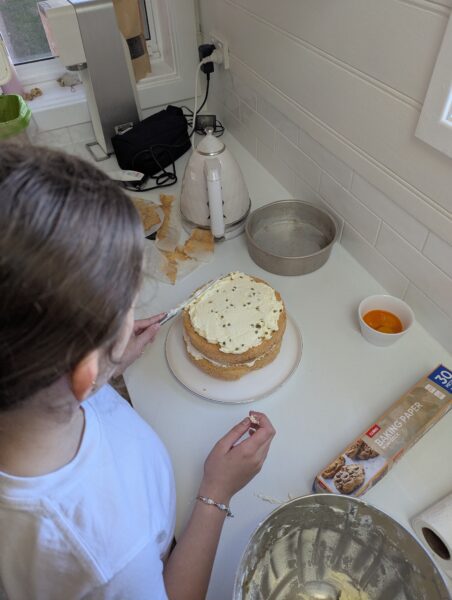
Image: A passionfruit sponge cooked with Nanny Maggie’s supervision
(No AI was involved in the baking of this cake).
Personally, we might ask ourselves:
- How can we make AI usage smaller, more ethical and more transparent?
- How can we make it less addictive?
- How can we make it beneficial to the environment?
Here is some good news. Some countries are using the heat generated from the AI data towers in innovative ways. In France they are using a system connected to the Large Hadron Collider that captures the heat and uses it to warm thousands of homes via district heating in winter.
Finland has been especially creative and innovative in using cooling systems from data centres to heat cities and tens of thousands of homes have benefited. A circular economy approach is being applied in some European countries where these systems capture and reuse evaporated water from the tower exhaust. This system uses industrial wastewater that is treated and reused in cooling towers, effectively turning them into water recycling plants. Some of these systems achieve 100% of recycled water use and this means freshwater is kept for human consumption rather than feeding hungry tech.
Hopefully, just as I have been after working on this book, you are now better informed about the full impact of AI usage in our modern world. Yes, it can make our lives better, and sometimes, especially with the nudifying apps, it can make life worse.
Either way, its excessive usage is having an impact on our physical world. This is why you need many conversations in your home and classrooms, so that our kids can get an accurate picture of the full impact, especially on their beautiful planet. Let’s hope we can have more innovative people create better ways of managing data centres so that they can contribute more benefit than harm.
Main image credit © By Scharfsinn/ Shutterstock
Your no-nonsense guide to growing up online
When it comes to teaching our kids and teens about the risks and benefits of AI, and how to be safe, kind, respectful digital citizens. Maggie’s newest book, co-authored with Kirra Pendergast, has got you covered. It’s a non-judgemental guide to helping your kids be the authors of their own digital lives.
Pre-order from maggiedent.com before publication day on 18th August and your copy will be signed by Maggie, and you’ll secure your spot in an exclusive online author Q&A with Maggie and Kirra.
PRE-ORDER NOW