



Newsletter Articles, Play & Nature Play, Posts for Parents, Screen time, digital & online safety
The digital tide is turning, finally.
As a parenting educator, I have read the research especially the neuroscience around the impact of screens on the development of children.
As far back as 2008 when I read ID: The Quest for Meaning in the 21st Century by neuroscientist Baroness Susan Greenfield, I have been concerned about the invisible impact on developing brains and how technology might impact how we shape our unique sense of self.
Teachers of five-year-olds have noticed over the last eight to 10 years a noticeable drop in fine and gross motor skills, smaller vocabularies, poorer self-regulation, inability to initiate and sustain play with other children, and much shorter concentration spans. Did we really need any more reason to question how technology has swamped childhood, and created a digital displacement that is definitely impacting the cognitive, emotional, physical and social development of our precious children? And yet nothing was happening.
The largest social experiment ever, and we just allowed it to swamp our homes, schools and communities.
What children need to grow and thrive in healthy ways has not changed. However, the world around our children has, and we collectively need to help turn the tide back to healthy child development.
When we shift our focus to the tween and teen years, the impact of screens, smart phones and social media becomes even more problematic.
Even a decade ago, Dr Mari Swingle wrote in her book i-Minds: How Cell Phones, Computers, Gaming, and Social Media are Changing our Brains, our Behavior, and the Evolution of our Species:
“As early as 2005 to 2008 we were aware that higher arousal and the dual or divided attention required for multitasking on multiple devices in multiple modes – doing homework while messaging and listening to music – was stressful and could reduce efficiency.
But it also slows the development of the frontal cortex. The divided attention required for multitasking thwarts the development of judgement and the ability to see the big picture.”
When Jonathan Haidt’s book The Anxious Generation arrived, it became the wake-up call we were all secretly yearning for, especially as parents and educators of tweens and teens. I have explored the digital harm that smart phones and social media have been causing our kids in an earlier blog.
Things have simply been getting worse and that was why I joined the 36 Months movement to raise the minimum age for social media accounts from 13 to 16. This initiative is an effort to help create guardrails that keep our under-16-year-olds a little bit safer — and to give our young people more time to develop without the influence of social media.
It’s much the same as how we have a legal age limit to drink alcohol or drive a car, we now have a legal age for the unfettered access by some platforms that have allowed not only harmful content, but harmful algorithms and have done little to keep our kids safe.
It’s interesting to watch their tokenistic efforts over the last few months, as Australia comes close to the December 10 deadline when age-restricted social media platforms will be required to “take reasonable steps to prevent Australians under the age of 16 from creating or keeping an account”.
There is much confusion out there about how this is happening and what does it include? For more clarity I suggest you watch my chat with my CTRL+SHFT colleague and Safe on Social founder Kirra Pendergast explaining it in more detail, and also keep checking the eSafety Commissioner’s excellent FAQ section about the social media restrictions.
Now for the good news
The second key message from Jonathon Haidt’s book was one about the shift around play that has impacted childhood.
Kids have not playing as much, in part because of screens, and this has costing them their health, happiness and wellbeing. In Australia we have seen escalating levels of childhood anxiety, ‘school can’t’ and higher levels of teens struggling with mental health challenges. Screens, phones and social media are of course not all to blame.
I am starting to hear of shifts that are happening that show the tide is turning. I have had a number of parents of primary school kids tell me that the nagging to get a phone has stopped. Kids under 16 are using messenger apps on their parents phones and some are even picking up the phone to call their friends! Yes, this means they are actually talking to each other which is incredibly important in terms of maintaining authentic connection, while avoiding all they nastiness that happens online. In America there are some communities that are going back to landline phones. Some Australian families are trying to do the same. Hallelujah!
Many teens under 16 are doing the same, and finding different ways to connect without allowing the algorithms to mess with their heads. Private WhatsApp groups are becoming more popular. Vimeo is providing a safer option for sharing videos than YouTube.
Many schools have banned phones long ago and anecdotally, I hear that they are continuing to notice the positive effects especially during breaks, and returning to playing more traditional games in breaks. I’m told too there is a palpable difference in the noise level of schools that have banned phones, as kids laugh, talk and engage IRL in the playground.
There is another shift happening in schools where they are beginning to really question the role of technology or EdTech, especially iPads and laptops. Our academic standards in Australia have continued to drop over the last 10 years, despite the promises that technology was going to improve educational outcomes. In Victoria a 90-minute screen time limit will be introduced to primary school students.
Schools are starting to question deeply how students learn and some are winding back tech and returning to paper. St Ignatius College in Adelaide is one such college that is taking a very intentional approach to technology. They are reducing digital technology use, right across the year levels. A more gradual introduction over time is preferred over throwing them into the deep end in the first years of schooling. And they are still aiming to prepare students to work in a digital landscape in respectful and responsible ways according to their cognitive development.
Some schools are creating spaces for boardgames during breaks. Others are introducing more adventuresome play equipment and others are bringing interesting play opportunities into schools like frisbees, kite making, paper planes and climbing walls.
The best way to encourage more play in upper primary and middle school is to consult with students. You will be amazed at how wise they can be when we prioritise having fun!
The change to legislation here in Australia has empowered families to have more conversations around no phones until high school, no social media until 16 – and something will start to shift at the grassroots level. I hear from parents who tell me their kids are starting to seek out other kids after school, and neighbourhood play is gradually reappearing. Some parents are telling me they are cutting back on extracurricular activities as well, keeping the same couple of days free to enable kids to do what kids are meant to do: play with other kids. One parent shared that in her cul-de-sac if any parent wanted to check where their kids were, they just needed to see which front lawn had the scooters parked on it.
The tide is turning.
Please reach out to your neighbours, school community, or your sporting club and work out ways we can create spaces for more real time connection. Start now so December 10 will be easier.
Remember autonomous free play with multiage children, of all genders is one of the best ways to build social and emotional awareness, physical competence, resilience and happier kids.
Huge thanks to the Australian Government for their leadership on this issue, to the E-safety Commissioner of Australia Julie Inman-Grant, to all my colleagues at CTRL+SHFT, especially Kirra who is working regularly with schools to support the coming changes and has advocated hard for change for a long time. And of course to the hundreds of thousands of parents who signed petitions and agitated for this change, and to the advocates who helped their voices be heard, including all the team at 36 Months, plus movements like The Heads Up Alliance, Before16 and Smartphone Free Childhood.
Let’s keep advocating for our children to be allowed to have a childhood.
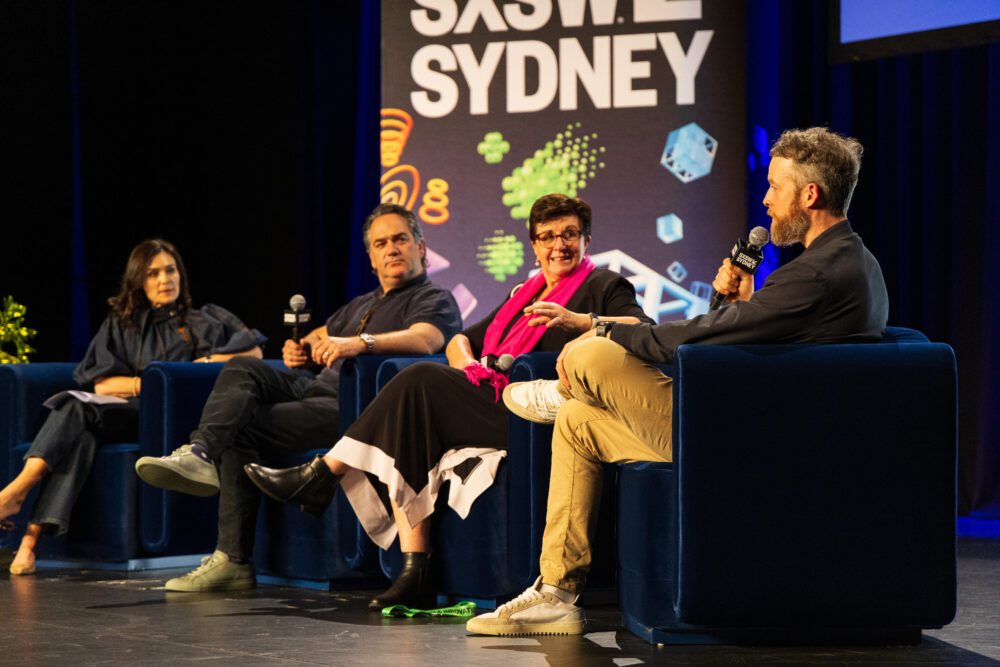
Image: supplied by 36 Months, from the SXSW panel in Sydney 2024 featuring Felicity McVay, Michael “Wippa” Wipfli, Maggie Dent and Hamish Blake.