


Building Resilience, Newsletter Articles, Play & Nature Play, Posts for Parents
Why I always say YES to puddles: Nature play and connection
Much has been written over the last 20 years about the concerns around raising children who are more disconnected from the natural world than previous generations.
Of course, the arrival of small screens has created a displacement effect for many, where the presence of a device that is designed to steal attention has made nature less appealing and less possible. Research suggests that the around 60% increase in myopia (short-sightedness) is not the screens’ fault, it’s the absence of time in nature where little one’s eyeballs have to adjust to many different visual lengths and distances!
Another thing that has stolen nature from our children is the norm of the overscheduled childhood – filling up every afternoon after school, and most weekends with sport, or arts activities – in order to help our children become the best they can be.
It seems that this generation of parents have been sold a story that being a human doing, is far more important than a human being.
The statistics clearly show, we have had a significant increase in children’s anxiety, and our teens are struggling on many levels at higher rates than previous generations did. Parental burnout and exhaustion are also at levels not seen before and that’s a combination of many factors.
Well, here is some good news!
Time – and the more the better – spent in nature is good for all of us.
Dr Kathleen Bagot did some research that showed that when environments like schools, childcare centres and aged care facilities were surrounded by more greenery, nature significantly impacted the wellbeing of those who attended. She described it as “the restorative effect of greenery”.
Over 20 years ago I met a wise and insightful woman in Boulder, Colorado whose work I had respected for a time. The late Rachael Kessler was the founder of the Passage Works Institute in Boulder, and the author of The Soul of Education (ASCD, 2000), a groundbreaking book on ways to transform public education. She was a highly esteemed leader for positive school change and also co-authored Social and Emotional Learning: Guidelines for Educators (ASCD, 1997), the first book to define and describe the field of social and emotional learning.
Her exploration of our need for belonging as a social species has never left me. In my work as a counsellor, when I was working with a teen or even an adult who was struggling, it always came back to a profound sense of disconnection in one or more of the following places in their life.
Deep Connectedness
- Deep connection to self
- Deep connection to another (family, friends)
- Deep connection to community (school, sport, faith, local)
- Deep connection to lineage (ancestry, cultural)
- Deep connection to nature and the environment
- Deep Connection to a Higher Power (the mysterious, the spiritual, the non-logical)
– Rachael Kessler, The Soul of Education (ASCD, 2000) p18
I was blessed to have been raised on a farm in south west Western Australia, where I was marinated in nature every single day. My whole family were deeply impacted by the cycles of life because we were dependent on them not just for survival, but to thrive. It could get really cold in Wandering, and I still have clear memories of walking on the lawn, ice crunching underfoot. There was no TV in my childhood, only ABC radio and so on some clear summer nights, our family would lay on blankets looking up at the sky spending hours picking out star constellations and watching the moon do its thing. I remember us trying to find the first Sputnik! Those childhood memories led me as a mother, to make sure my boys were aware of the night sky. I often made them come outside on a full moon and make wishes!
One night when all the boys had moved out, living in Perth at university or working, there was a really interesting moment in the night sky when the new moon had two bright planets above it, and it looked like a face. Each of my boys, independent of the others, took a photo and sent it to me! I was delighted.
Not only can nature be restorative, it can be a powerful connector just as Kessler had explored. Moments of awe and wonder are good for us all.
The power of the puddle
I have been a grandmother for almost 12 years and so I have witnessed and celebrated the power of the puddle many times in those years. As a mother of four energetic boys, who seemed always to have been able to find a puddle, I learned early on to keep spare towels and underpants in the back of our car. Whatever the weather, if there was a puddle, my boys would find it and my get in it!
While jumping in puddles seems like a way of just having fun, it is so much more than that.
I have been really grateful to have had my understanding about nature and nature play enhanced by so many wonderful humans like Richard Louv, Dr Peter Gray, Tim Burns, Gillian McAulliffe, and the team at Educated by Nature, Daniel Burton and Trudi Bennett, to name just a handful.
While spending time in nature has enormous benefits, playing in nature adds a whole new dimension.
The whole body, with all Its sensory systems working together to navigate the unpredictability of the natural world, helps build healthy bodies and brains and it does that through movement.
“Sight combined with balance, movement, hearing, touch and proprioception (feedback from the muscles, tendons and joints, informing the brain about the body’s status and actions at any moment in time) help to integrate sensory experience and can only take place as a result of action and practice. Movement is the medium through which this takes place.
— Sally Goddard Blythe, What Babies and Children Really Need (2008).
On the subject of movement… 2-8 November 2026 is KIDDO’s Physical Literacy Week, a free national celebration of play for kids Birth-12. Participants receive free, ready-to-use activities and resources that make it easy to get involved — whether for one activity, one day or the whole week. Check it out here.
Puddles can be invitations to explore, to be brave, to have fun and most importantly, be free. It is play in its purest form and the puddle invites autonomy. So much of the extracurricular activities that our children participate in are driven by adults, with very specific outcomes intended. That is not how children learn the best.
As Daniel from Educated by Nature explains on their website:
Play itself is an act of hope. Children constructing cubbies from sticks, inventing worlds in mud kitchens, balancing across logs, climbing trees, building with loose parts, creating stories and games together – none of this is trivial. Play is experimentation. Play is adaptation. Play is imagination. Play assumes that new possibilities can emerge. In many ways, it is one of the most powerful antidotes we have to hopelessness.
The power of the pause
Have you noticed that sometimes when you take yourself outside into a space in nature, especially with a cuppa, that often you feel the need to sigh or take a deep breath? You don’t have to think about it, it just happens.
In childhood our children are really good at living in the moment, which is why it can be so annoying when we want them to live in the next moment and get ready for school!
Creating quiet moments in nature can happen with babies and toddlers, and often can give weary parents, an opportunity to relax as well.
Nicole Pates a paediatric physiotherapist has a written an excellent book called Purposeful Play: From birth to walking; simple fun baby plays for growth in connection and in it she explores really easy ways of giving babies and toddlers simple activities to do outdoors.
One such activity is called the Great Pea Rescue and all that is needed is a deep pot, large bowl or baking dish, some water, frozen peas and a towel for easy cleanup. What I love about Nicole’s work is so much of it does not require you to spend money to buy things for your baby or toddler. They are already in your house. You can find her and her helpful reels here.
Creating unhurried moments in childhood, from as early as possible, allows our children to experience something exquisite that helps them later in life. It is called natural transcendence. This is a moment where a child can slip into a state where everything is suspended. Time stops, demands stop and they are just “being” – fully present to one moment in time.
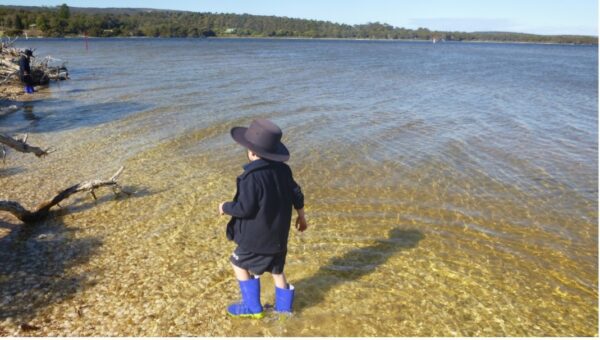
I once was observing a group of five-year-olds at the Wild Space at the Great Southern Grammar School in Western Australia. The kids were able to visit this space with their teachers three times a week to be immersed in autonomous connection with nature. I watched this little boy in the picture above and noticed that he had paused – he had slipped into this magical state. I timed how long he stood still like that focused on the water. It was eight and half minutes. As he turned to return to the shore he sighed. I said to him, “hey you look like you were looking for something, were you?” He replied, “Yes.” I asked what and he replied, “Whales.” I asked, “did you see any?” And he replied, “not today!”
If you notice, the water that he had been observing over eight and half minutes was less than half a metre deep. The magic of observing this beautiful boy so deeply connected to nature with so much hope, brought tears to my eyes.
Creating these spaces in nature, does not require a lot of effort from parents.
Parents can simply create the opportunity and sit nearby hopefully with a really good takeaway coffee in a keep cup. Daniel Burton writes about researcher Dr. Mariana Brussoni’s work, which “highlights that when adults step back and allow children space, they gain not only joy but also the resilience that comes from navigating challenge and uncertainty.”
In fact, as I write, Dr Brussoni has just co-authored a paper about a new international systematic review which looked at 74 studies and found “promising associations between outdoor risky play, supportive play environments, and children’s physical health, mental well-being, social and cognitive development, and risk competence”.
When our kids are able to see that their grown-up is comfortable with then being in nature, without the pressure of staying clean and tidy, or staying safe or staying inside, they thrive.
The key is simple – nature play thrives when we say yes.
Yes to mud.
Yes to rain.
Yes to sticks.
Yes to rocks.
Yes to beaches.
Yes to hills.
Yes to puddles.
Yes to getting dirty.
Yes to joy.
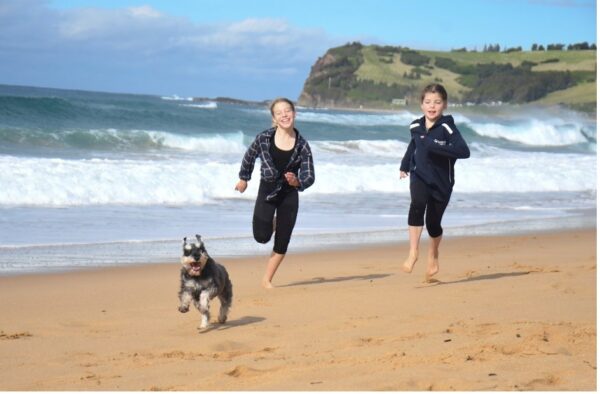
There is an absolute wealth of research that supports the idea that living in greener environments and spending time in nature (and with companion animals) can benefit our children’s emotional wellbeing and mental health. Often this is especially so for our most marginalised kids.
This can mean better capacity for self-regulation; more positive moods; improved resilience and ability to deal with stress; higher self-esteem; and more positive social interactions.
Nature is good for us grown-ups too
When I was a busy mum raising four energetic boys and working full-time I found nature was my solace, my safe base and my best friend. Having a chair in my garden where I could escape with a cuppa, when there was too much noise and wrestling happening inside, helped me calm my own nervous system and reminded me what really mattered.
Prioritising time outside was another one of my wisest decisions as a parent. Yes, we did linger longer at the beach some afternoons, and as a result dinner was very simple, yet nutritious. Yes, there were times I really wanted to get home to get stuff done, but I just surrendered to our family experiencing something special in the natural world.
As a grandmother I continue to prioritise connection to nature with my grandies. I overheard two of my sons speaking one day about what they’d noticed when they took the kids to the park. They were complaining because the kids tended to want to play amongst the bushes and the rocks that surrounded the playgrounds rather than in the playgrounds themselves. Which is exactly what I left them do when I take them to the playground. Also, apparently, “they always want to bring home something special and we already have lots of ‘special’ sticks and stones at home!” I chuckled to myself.
For families and school communities everywhere, prioritising time in nature and nature play may be a choice that can bring some calmness and glimmers of joy without any agenda. It can help us all build a deeper connection to a sense of belonging that we forgot we needed. If this connection time is spent with people we love and value, the sense of belonging will be enhanced even more and maybe, just maybe, we could lower the loneliness statistics for our teens and adults.
For inspiration, check out some of these sites!
- My nature play gallery
- WA really has led the charge in nature play in Australia. Nature Play WA has some great resources for families, educators and communities.
- Educated by Nature is run by leading Nature Connection Mentors Daniel and Trudy. Based in WA, they often share great resources and ideas for outside of WA. educatedbynature.com
- Gillian McAuliffe is the Creator at the Nature’s Atelier in WA and she was also the founder of Bold Park Community School. And check out what they are doing at Nature’s Atelier for your own inspiration.
- Nature Play Australia
- Nature Play NSW
- Tania Maloney’s Nurture in Nature program runs PDs & programs to help early years and primary schools incorporate more nature play. And I love her Nature Ninja picture book!
- Lukas Ritsen & his team from Wearthy help create nature playgrounds as well as running education programs in purposeful, nature-connected play.
- Childspace in NZ have some great early childhood nature play education resources and a workshop where they design and build nature play stuff.
- Outdoors Qld and Outdoors NSW & ACT have some great information and inspiration for anyone engaged in outdoors education.
- Dr Kathleen Bagot (who’s research I mentioned earlier) runs programs and shares resources via her website at nothinglikenature.com.au
- Outside Play UBC Lab is a team of researchers dedicated to studying children’s outdoor risky play, and publish some fascinating research. They also have some toolkits for parents, teachers and early childhood educators.
Image credits: Main image Deposit Photos / Authorromrodinka
Other pics supplied by Maggie Dent