


HELPLINES - for immediate support + GOOD GENERAL RESOURCES
Remember if someone’s life is in immediate danger, you should call the emergency number 000 (in Australia – if you are elsewhere, please dial the appropriate number).
There are many Australian support services, helplines and websites for adolescents who feel they need to connect with someone to help them feel safe, accepted, and heard. Many offer email or web counselling and live chat if you prefer not to call. Also don’t forget your regular GP can be a helpful starting point if you want to talk to someone and would like to set up some ongoing counselling.
Kids Helpline
Call anytime for any reason or visit their website for more instant help. 1800 55 1800
kidshelpline.com.au
Suicide Callback Service
24/7 telephone and online counselling to people who are affected by suicide.
1300 65 94 67
suicidecallbackservice.org.au
Lifeline
24/7 phone crisis support for suicide prevention. 13 11 14
lifeline.org.au
ReachOut
Australia’s leading online mental health organisation for young people and their parents.
au.reachout.com
Headspace
Helping you understand and work through life’s challenges. Also, they have a great function on their home page for parents or adolescents to quickly find tailored information, online support, work and study support or a local head- space centre.
headspace.org.au
Youth Beyond Blue
Helping young people respond to anxiety and depression.
youthbeyondblue.com
13YARN
For Aboriginal and Torres Strait Islander people who are going through a tough time and feel like having a yarn.
13 92 76
13yarn.org.au
1800 RESPECT
A service if you or someone you know is experiencing sexual assault or domestic and family violence (all ages).
1800 737 732
Online text chat – 1800respect.org.au
Some respected and much-loved teen experts
- Lisa Damour, clinical psychologist, author, speaker, researcher
- Claire Eaton, author, speaker, youth mindset coach
- Andrew Fuller, clinical psychologist, author, ambassador for Mind Matters
- Dr Vanessa Lapointe, author, parenting coach
- Michelle Mitchell, author, speaker, educator
- Claire Orange, co-founder, Best Programs 4 Kids, founder of DiGii Social
- Tina Payne-Bryson, researcher and author
- Nancy Reynolds, Raising Teens Today
- Daniel J Siegel, M.D. researcher and author
- Karen Young, Hey Sigmund
- Lyn Worsley, The Resilience Doughnut
- The Lancet Psychiatry Commission on Youth Mental Health has some excellent papers on youth mental health
Mentoring organisations and Rites of Passage programs
- Youth off the Streets
- The Raise Foundation
- Youth Focus, WA
- Sister2Sister, Sydney
- Zero2Hero, Perth
- The Rites of Passage Institute
- The Rite Journey
- Fathering Adventures
- The Fathering Project
- True North Expeditions
Here’s a longer list on my website recommended by my community.
Apps
There’s a good list of apps for teens at: au.reachout.com/tools-and-apps
And also here at https://kidshelpline.com.au/tools/apps
Depression
Resources for the chapter on ‘When is a moody or grumpy teen a depressed teen’
You can visit your family doctor or GP to get a referral to see a psychologist wherever you live. In Australia, when your teen sees a GP, they may be able to access a Mental Health Care Plan, which is funded by Medicare to allow your teen to access up to 10 sessions with a psychologist, accredited OT, or social worker. Each state also has a dedicated child and adolescent crisis line, which teenagers can access, usually called the Child and Adolescent Mental Health Services (CAMHS). This can provide valuable local support.
Also, there are comprehensive lists of helplines and support services through- out Australia at emhprac.org.au/resource/digital-mental-health-for-young-people/ and at au.reachout.com/tools-and-apps. Here are some key ones that may help:
- kidshelp.com.au
- au.reachout.com
- headspace.org.au
- youthbeyondblue.com
- brave4you.psy.uq.edu.au
- coolkids.org.au
- headtohealth.gov.au
- andrewfuller.com.au/free-resources
- zero2hero.com.au/youth-resources
- heysigmund.com
- raisingteenstoday.com
- cci.health.wa.gov.au/resources/looking-after-yourself
- moodgym.com.au
- The Lancet Psychiatry Commission on Youth Mental Health has some excellent papers on youth mental health
- most.org.au – MOST provides online support to young people experiencing mental ill-health.
It has small bites of proven therapeutic content, cartoons, activities and practical strategies that work and offers, safe, moderated online community discussions, and access to clinical and vocational experts and peers
Podcasts, apps & other resources
- Smiling Mind app
- Headspace app
- The Mello app from Orygen is the world’s first clinically designed app to address rumination – aka ‘stuck thinking’.
- ClearlyMe®️ app for Teens – Black Dog Institute
- Not Alone – A Beyond Blue podcast
- Well Hello Anxiety podcast with Dr Jodi Richardson (especially episodes 73, 84, 85, 86, 87)
- Minding Your Mind podcast with Prof Ian Hickie & James O’Loghlin
- Better Than Yesterday with Osher Günsberg
- This is Normal: A Podcast About Youth Mental Health
- Dear Hank & John hosted by John and Hank Green, authors, and YouTubers. (You may recognise John Green as the author of YA bestselling novel The Fault in Our Stars).
- Speaking of Psychology – the American Psychological Association podcast has some good episodes on adolescent/teen psychology.
- Generation Next has a free online professional development program, Supporting Young People in Times of Uncertainty
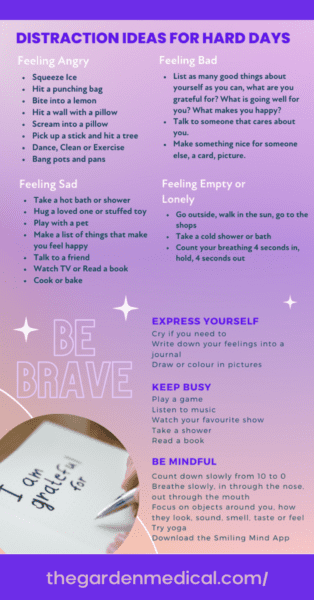
Dr Andrew Leech from The Garden Medical in WA (who wrote this guest blog for Maggie’s site about the top issues his teen patients face) created this ‘coping card’ for his patients:
Books
- Dr Lisa Damour The Emotional Lives of Teenagers and Under Pressure: Confronting the Epidemic of Stress and Anxiety in Girls and Untangled: Guiding Teen Girls Through Seven Transitions Into Adulthood
- Maggie Dent, From Boys to Men
- Jonathan Haidt, The Anxious Generation
- Katie Hurley, LCSW, The Depression Workbook for Teens: Tools to Improve Your Mood, Build Self-Esteem, and Stay Motivated
- Dr Ginni Mansberg & Jo Lamble, The New Teen Age: How to support today’s tweens and teens to become healthy, happy adults
- Michelle Mitchell, What teenage girls don’t tell their parents
- Michelle Mitchell, Parenting Teenage Girls in the Age of a New Normal
- Dr Jo Prendergast, When Life Sucks: Parenting your teen through tough times
- Daisy Turnbull, 50 Questions to Ask Your Teens
Vaping
First, remember that your teen may need the support of a doctor/general practitioner to come off vaping if they are addicted to nicotine.
Websites
Wherever you are in the world, the following websites have information, fact sheets for parents and teachers and tips for talking with teens about vaping and supporting them to stop.
- darta.net.au
- positivechoices.org.au
- In UK – talktofrank.com and the NHS Better Health websites.
- In Ireland, the Heart Foundation website has some good information on vapes.
- Reachout has some great information for young people on why vaping is addictive.
- The US CDC website, cdc.gov has lots of information on ‘electronic cigarettes’
- In Canada, you can get some good advice and support links at the Canadian Government site: canada.ca/en/health-canada
- Vaping lingo dictionary – Truth Initiative. This is an interesting dictionary of popular phrases, products and general language used in relation to vaping which may help you better understand them.
- The Truth Initiative also has some top tips for parents and educators on vaping prevention and quit resources.
Podcasts
- Paul Dillon’s Doing Drugs with Paul Dillon. Also check out Paul’s podcast for young people called The Real Deal on Drugs with Paul Dillon – episode on vaping. You can get both on Spotify and Apple Podcasts. And find the show page here.
- Square Peg Round Whole episode on Vapes, Alcohol, Drugs (with a neurodivergent lens)
- Parental As Anything episode on vaping
- RCH Kids Health Info episode – ‘How harmful can vaping be?’ – they also have a fact sheet and video on this page.
- Ask Lisa: The Psychology of Parenting with Dr Lisa Damour and Reena Ninan’s podcast episode 103 – ‘How do I talk my teen out of vaping?’
- The Generation Next podcast with Andrew Fuller – ‘Current Trends of Substance Use in Young People’
For more resources on quitting nicotine
- Hooked on Nicotine Checklist –from health.nsw.gov.au
- The US Government’s site smokefree.gov and they have two apps: QuitGuide and quitSTART
- iCanQuit – The Australian Government’s Quitline site and hotline 137 848
- Many country’s health departments have equivalents to Quitline so search ‘quit smoking’ to find the site most relevant to you.
- Read The Conversation article, ‘My teen is addicted to vaping. How can I help them quit and manage their withdrawal symptoms?’
- My Quit Buddy app
- Smoke Free Teen has some great strategies for quiting
- UK – FRANK – Text 82111, phone 0300 1236600 or find a support centre or email via talktofrank.com
- Some good resources at lung.org/quit-smoking on ‘helping teens quit’
- They also have an online Not On Tobacco® (N-O-T) program for teens aged 14–19 to help break their dependence on nicotine, whether that come from vaping, smoking, or using other tobacco products: notforme.org
Puberty, Sex & Consent
Websites
(Search ‘sex’ on the sites below that are not specifically dedicated to puberty and sex education.)
- au.reachout.com
- raisingchildren.net.au
- talkingthetalksexed.com.au
- sexedrescue.com – Also check out Cath Hakanson from SexEd Rescue’s wikiHow profile)
- anatomyforkids.com
- drlisadamour.com
- michellemitchell.org
- dads4kids.org.au
- scarleteen.com
- respect.gov.au (has great resources on respectful relationships)
Books
- Chanel Contos, Consent Laid Bare
- The Sex in Space Project has a book, How to Talk With Your Kids About Porn
- Vanessa Hamilton, Talking Sex: A Conversation Guide for Parents
- Dannielle Miller and Nina Funnell, Lovability: An Empowered Girls Guide to Dating and Relationships
- Michele Mitchell, A Girl’s Guide to Puberty
- Peggy Orenstein, Girls and Sex: Navigating the Complicated New Landscape and Boys and Sex: Young Men on Hook-ups, Love, Porn, Consent and Navigating the New Masculinity
- Collett Smart, They’ll Be Okay: 15 Conversations to Help Your Child Through Troubled Times
- Andrew Smiler, Dating and Sex: A Guide for 21st Century Boys
- Yumi Stynes and Dr Melissa Kang, Welcome to Consent and Welcome to Sex (Some of the stuff in this book may be confronting. I suggest you check it out yourself before passing it onto your teen).
- Rachel Coler Mulholland (aka Shug CM on TikTok where she has almost 1million followers) The Birds, The Bees & the Elephant in the Room.
Podcasts, videos and other resources
- Tomorrow Man has a great resource on talking to boys about masculinity and respectful relationships.
- Parental As Anything episode on talking to kids about sex.
- The Sex in Space podcast has some fascinating episodes.
- Speaking of Psychology episode on How to talk to teen boys about dating and sex, with Andrew Smiler, PhD
- Peggy Orenstein TED talk – ‘What young women believe about their own sexual pleasure’.
- Help! I Have A Teenager with Dr Ginni Mansberg and Jo Lamble – episode called So . . . You Just Found Out Your Teen is Having Sex
- Cath Hakanson has links to some fantastic sex education videos for tweens and teens on her website, plus some videos for teens with scientific explanations of how our bodies work during sex
- Popular TikToker and therapist Rachel Coler Mulholland talks The Sex Ed You Should have Gotten on the Struggle Care podcast.
- The Canadian Broadcasting Corporation has an excellent video series called ‘About Sex’ for adolescents.
- You can also find some great podcast chats about talking to your teens about sex by putting some key experts’ names into your podcast app: Peggy Orenstein, Vanessa Hamilton, Dr Melissa Kang, Cath Hakanson.
Sexuality & Gender Identity
Helplines/web support
- Qlife LGBTI phone and chat counselling and info service, phone 1800 184 527 (3 pm–12 am every day) or go to qlife.org.au
- eHeadspace:headspace.org.au
- ParentLine: 1300 1300 52
- Suicide Call Back Service available 24/7: 1300 659 467
- Non-urgent mental health support is available through Headspace on 1800 650 890.
- reachout.com has a great list ‘LGBTQIA+ support services’ across Australia. They also have a great list of culturally diverse LGBTQIA+ support services and groups)
- Transcend Australia (transcend.org.au) has resources for trans, gender diverse, non-binary and gender-questioning teens and their families.
- Rainbow Door rainbowdoor.org.au
- Minus18.org.au
- glaad.org
- Safe Schools
- Sam Killermann’s ‘The Genderbread Person’ – a useful explanation of sex, gender, sexual orientation and gender expression.
- Parents of Gender Diverse Children (pgdc.org.au)
- Kids Helpline has some useful tips on gender identity (search at kidshelpline.com.au)
- The Trevor Project – US (thetrevorproject.org)
- GLSEN – a US network to make schools safe and supportive for all students
- The LGBT National Hotline – US (lgbthotline.org)
- youngminds.org.uk – UK
- In Canada (with French translation), healthiertogether.ca has useful tips on talking with kids about sexual and gender diversity
- VPN Mentor has a useful online safety guide for LGBTQIA+ people
Podcasts
- Parental As Anything episode on Kids and Gender
- Telethon Kids Institute Embracing the Mind episode on gender diverse and trans young people’s mental health
- Just Breathe: Parenting Your LGBTQ Teen
- Help! I Have A Teenager with Dr Ginni Mansberg and Jo Lamble has a couple of episodes on gender and sexuality including How to Talk to Your Teen About Their Sexuality and an episode on Wrapping your Head Around Your Teen’s New Pronouns
Books
- Robyn Fausett and Molly Fausett, The Kids Will Be All Right: A guide to raising teens in a complex world
- Dr Ginni Mansberg and Joe Lamble, The new teenage: How to support today’s tweens and teens to become healthy, happy adults
- Dr Jo Prendergast, When Life Sucks: Parenting your teen through tough times
- There is a good list of books for LGBTQI+ teens and their parents at rainbowfamilies.com.au
Drugs
What to do when you find a bong, some weed or a small plastic bag with random pills in it
More resources
In Australia, we have National Alcohol and Other Drug Hotline – 1800 250 015. The hotline will automatically divert you to the Alcohol and Drug Information Service in your state or territory. These services offer support, information, counselling and referral to other services
Also, it’s a good idea to get your teen to download and learn how to use the Emergency+ app, which uses GPS to help a Triple Zero (000) caller provide critical location details to emergency services
Websites
- reachout.com
- positivechoices.org.au – this site has everything from factsheets, webinars, videos, apps and games to educate about making safe choices
- adf.org.au – Alcohol and Drug Foundation
- DARTA blog ‘Doing Drugs with Paul Dillon’ at darta.net.au
- Paul also has free Digital-Cards ‘app’ that helps empower teens to handle tricky situations like when a friend greens out or has a panic attack.
- Paul Dillon and I did a masterclass on ‘Alcohol, Drugs, Parties & Teens’.
- UK – FRANK – Text 82111, phone 0300 1236600 or find a support centre/ email via talktofrank.com
- US – Substance Abuse and Mental Health Services Administration (SAMHSA). National Helpline on 1–800–662–4357 or samhsa.gov
Podcasts & Videos
Paul Dillon has two podcast series. I also highly recommend that you listen with your teen to get up-to-date balanced information at any time. You can find them at darta.net.au//podcasts.
- Doing Drugs with Paul Dillon
- The Real Deal on Drugs with Paul Dillon
- The Australian Government Student Wellbeing Hub has a video on Drugs and the Teenage Brain
- The Help! I Have a Teenager podcast has a few episodes about drugs including this one on nangs
- Parental As Anything has touched on drug use in an episode of about pot-smoking party girl
- The American Psychological Association Speaking of Psychology podcast has an episode on Marijuana: The Brain Changer
Books
- Paul Dillon, Teenagers, Drugs and Alcohol
- Robyn Fausett and Molly Fausett, The Kids Will Be All Right: A guide to raising teens in a complex world
- Dr Jo Prendergast When Life Sucks: Parenting your teen through tough times
Alcohol
What to do when your teen comes home seriously drunk
National Alcohol and Other Drug Hotline
If you are ever worried while your child is drunk or after, you can get free and confidential advice about alcohol and other drugs from the National Alcohol and Other Drug Hotline – 1800 250 015. The hotline will automatically divert you to the Alcohol and Drug Information Service in your state or territory. These services offer support, information, counselling and referral to other services.
Again, if you know your teen’s now drinking, it’s a good idea to get them (and you) to download and learn how to use the Emergency+ app, which uses GPS to help a Triple Zero (000) caller provide critical location details to emergency services.
Websites
- drinkwise.org.au – loads of resources and the ‘how to deal with teen drinking‘ page is a good place to start. And they have some campaigns here.
- positivechoices.org.au
- adf.org.au – Alcohol and Drug Foundation
- DARTA blog ‘Doing Drugs with Paul Dillon’ at darta.net.au
- Paul also has a free Digital-Cards ‘app’ that helps empower teens to handle tricky situations like when their friend has alcohol poisoning, is really drunk or the like.
- Paul and I also did a masterclass on ‘Alcohol, Drugs, Parties & Teens’.
Books
- Paul Dillon, Teenagers, Drugs and Alcohol
- Robyn Fausett and Molly Fausett, The Kids Will Be All Right: A guide to raising teens in a complex world
- Dr Jo Prendergast When Life Sucks: Parenting your teen through tough times
Podcasts and videos
- Help! I Have A Teenager with Dr Ginni Mansberg and Jo Lamble – episode on Parties, Drinking And The Problem with ‘Giving Up’ On Your Teen.
- The Australian Government’s Student Wellbeing Hub has a podcast on Drugs and the Teenage Brain
- Parental As Anything (Teens) episode with Bec Sparrow, Is it OK to let my teen drink alcohol?
Bullying/Cyberbullying
What to do when your teen is experiencing significant bullying, including cyberbullying
Websites
- esafety.gov.au
- ctrlshft.global
- digiisocial.com
- safeonsocial.com
- stymie.com
- bullyingnoway.gov.au
- dollysdream.org.au
- alannahandmadeline.org.au
Counselling and helplines
The eSafety website has a comprehensive list of support sites here:
esafety.gov.au/ about-us/counselling-support-services
But here are a few key ones:
- Kids Helpline: kidshelpline.com.au or call 1800 55 1800 (5–25 years)
- ReachOut: au.reachout.com (under 25s)
- SANE Australia: sane.org or call 1800 187 263 (18+ years)
- eHeadspace 1800 650 890 (available 9am to 1am, every day, for young people between 12 and 25) headspace.org.au
- Lifeline 13 11 14 (available 24/7, for all ages)
- qlife.org.au 1800 184 527 (available 3pm to midnight, every day, for all ages)
- 1800RESPECT 1800 737 732 (available 24/7, for all ages)
- MensLine Australia 1300 78 99 78 (available 24/7, for men of all ages)
- The eSafety Commissioner is the place to go if you’re a victim of image based abuse.
- VPN Mento has published some useful resources here for LGBTQIA+ people experiencing cyberbullying.
Podcasts
- Parental As Anything has a couple of episodes on cyberbullying, including one what you need to know before giving your child a smartphone and another on protecting your teen from cyberbullying
- SBS has a podcast series called Harmful, which interviews specialists in mental health, behaviour and provides educational insights on how we can better tackle bullying
- The Generation Next podcast with Andrew Fuller has a couple of helpful episodes on bullying including one on Understanding Bullying and another on Bully Blocking
- Help! I Have A Teenager with Dr Ginni Mansberg and Jo Lamble has a couple of episodes on bullying including one on what to do if your child is a bully
Books
- Claire Eaton, ROC and Rise: The teenager’s guide to building resilience, optimism and confidence needed to level up at school, in relationships and life
- Robyn Fausett and Molly Fausett, The Kids Will Be All Right: A guide to raising teens in a complex world
- Dr Ginni Mansberg and Jo Lamble, The New Teen Age: How to support today’s tweens and teens to become healthy, happy adults
- Sharon Witt, Wise Guys and Girl Wise (guides to school).
Problematic Phone Use
What to do when your teen’s phone use becomes problematic
Some resources for more help
- I recommend Brad Marshall’s book, How to Say No to Your Phone as a comprehensive guide. He’s also worth following @unpluggedpsychologist on socials.
- Similarly, Dr Kristy Goodwin’s book and online resources around her book, Dear Digital, We need to talk are great and she’s worth following on socials too!
- If you’ve got a 9-15year old and you’re thinking about getting them a phone, this article from raisingchildren.net.au has some helpful considerations.
- As well as his book, The Anxious Generation, Jon Haidt has a very informative Substack called ‘After Babel‘. AND excellent resources at his FreeTheAnxiousGeneration website.
- Safe On Social are great to follow on LinkedIn too (and check out their blogs) — In June 2025, we formed ctrlshft.global, a coalition formed by SOS founder Kirra Pendergast and also including me, Brad Marshall and child safety and victims advocate Madeleine West.
- Claire Orange from DiGii Social also has some great reads on their site including a blog on tips to cut back your tween’s screen time.
-
Yas London regularly offers useful tips for parents helping their kids/teens navigate digital life on her Instagram page.
- Worldwide, the Smartphone Free Phone Childhood movements are bringing parents together. Click here for the NZ chapter’s resources and the UK website has lots to share too.
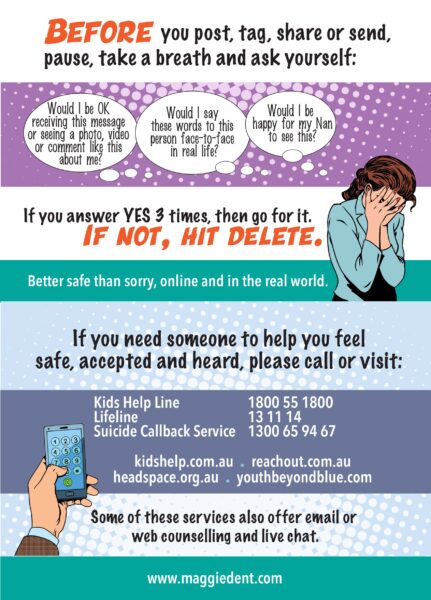
- And you can download my social media reminder graphics:
Books
- Robyn Fausett and Molly Fausett, The Kids Will Be All Right: A guide to raising teens in a complex world
- Dr Kristy Goodwin, Dear Digital, We Need to Talk: A guilt-free guide to taming your tech habits and thriving in a digital world
- Brad Marshall and Lindsay Hassock, How To Say No to Your Phone
- Johann Hari, Stolen Focus: Why You Can’t Pay Attention
- Jonathan Haidt, The Anxious Generation: How the Great Rewiring of Childhood is Causing an Epidemic of Mental Illness
- Mari Swingle, i-Minds: How Cell Phones, Computers, Gaming, and Social Media are Changing our Brains, our Behavior, and the Evolution of our Species
Podcasts & videos
- Parental As Anything episode on teens, smartphones and how to get it right.
- Kirra from Safe on Social has been on lots of podcasts talking about digital life for kids and teens. You can find a full list here.
- Also, it’s really worth throwing all of the above authors’ names into the search on your podcast app for some good chats on taming your phone use!
- Also I did an online masterclasses with Dr Kristy Goodwin on Teens on Tech
Problematic Gaming
What to do when your teen’s gaming becomes problematic
Some resources for more help
- I recommend Brad Marshall’s book, The Tech Diet for your Child & Teen as a guide, as it’s full of great suggestions and insights, and if you follow him on Instagram and Facebook, he has lots of ‘bite-size’ tips around this topic.
- He also has a parent tutorial video series at unpluggedpsychologist.com.au
- raisingchildren.net.au has a recorded webinar on ‘Gaming: how to make the most of it in your family’, for families of 11–16-year-olds who want to learn more about their adolescent’s gaming and how to make the most of it. Also check out their whole section on ‘gaming & gambling’.
- If you’re in Australia and your child is at the more severe end of use, and/or you would like an expert opinion, you can make a referral to The Screen & Gaming Disorder Clinic for assessment by a professional.
- You can visit your family doctor or GP to get a referral to see a psychologist wherever you live. Some sites (like, here in Australia, the Australian Psychological Society) allow you to search for counsellors that specialise in addictions/compulsions in whichever country/area you live in.
- Brad mentioned resetsummercamp.com has an online digital detox roadmap that may be helpful.
- A few years back, Kids Helpline teamed up with some of Australia’s best gamers to run a Twitch session (that’s where you watch others game and commentate while they do so) in which they talked about mental health. Could be a useful entrée for a gaming teen. Check out ‘Truth ‘n’ Loot’.
- gamequitters.com is a global support community for gamers and families with members from 95 countries. It has an informal quiz parents can take to determine if their child may have an issue. They also have a podcast called Gaming the System.
- The 12-step program is not for everyone but Gaming Addicts Anonymous has an online self-test for gaming addiction and a section for family and friends that may be useful for you to check out as a parent.
Body image & eating disorders
What to do when your teen hates their body, and you suspect their eating habits might be disordered
Websites and support
- Butterfly – for eating disorder support. Phone 1800 33 4673 (1800 ED HOPE) or visit butterfly.org.au
- Butterfly’s Body Pride Resource Hub has resources specific for LGBTQIA+ adolescents and adults
- Among other resources, the Eating Disorders Alliance of Australia has a great fact sheet on ‘how to start the conversation’
- The National Eating Disorders Collaboration has some great resources for families, supports and those with lived experience, and they come in several languages
- The WA Centre for Clinical Interventions has some self-help resources for body dysmorphia and disordered eating at health.wa.gov.au/resources/ looking-after-yourself
- Eating Disorders Families Australia
- Health at Every Size Australia (haeaustralasia.org.au)
- Inside Out Institute (Australia)
- Internationally, F.E.A.S.T (Families Empowered and Supporting the Treatment of Eating Disorders) is a global support and education community of and for parents of those with eating disorders. Website: feast-ed.org and forum: aroundthedinnertable.org
- The Be Real Campaign – UK
- healthline.com has a list of the best eating disorder recovery apps
Podcasts
- Parental As Anything episodes on ‘My teen has an eating disorder’ and ‘Teaching Your Kids Body Positivity’
- Butterfly’s Let’s Talk podcast: this podcast has four seasons of great chats about body image and eating disorders
- Generation Next podcast with Andrew Fuller – ‘Eating disorders in young people’
- Speaking of Psychology podcast episode – ‘Getting teens to eat healthy’
Books
- edfa.org.au has a list of the top 30 eating disorder books for parents and carers, so I recommend you start there
- 2023 Australian of the Year Taryn Brumfitt’s book Embrace Yourself and her documentary Embrace could be an inspiring watch/read
- Dr Jo Prendergast, When Life Sucks: Parenting your teen through tough times
Self-harm
What to do when you discover your teen is intentionally self-harming
You can visit your family doctor or GP to get a referral to see a psychologist wherever you live. Some sites (like, here in Australia, the Australian Psychological Society) allow you to search for counsellors that specialise in addictions/ compulsions in whichever country/area you live in. There are some specialised units at some large city hospitals.
Websites
Search ‘self-harm’ at
- kidshelpline.com.au – A good starting point is this overview on self-harm
- orygen.org.au
- headspace.org.au
- youngmindsmatter.org (a Telethon Kids Institute website)
Consider training in Mental Health First Aid. (MHFA) Australia has an ‘ALGEE’ action plan that includes:
A – approaching, assessing and assisting with any crisis
L – listening non-judgementally
G – giving support and information
E – encouraging appropriate professional help
E – encouraging other supports.
Dr Andrew Leech from The Garden Medical in WA (who wrote this guest blog for Maggie’s site about the top issues his teen patients face) created this ‘coping card’ for his patients:
Andrew also recommends these resources (specific to WA but some will be helpful beyond).:
- DBT Teen – DBTeen is a dialectical behaviour therapy (DBT) informed program delivered in a Primary Care environment, offering skills training for young people aged 14-18 (including those experiencing self-injury) – https://wa.lifeline.org.au/services/dbteen/
- The Luminos Project – is a non-medical, short-stay residential service for young people aged 16-24 experiencing thoughts of suicide. Referral can be found here: https://thesamaritans.org.au/the-luminos-project/
- Freedom WA – Free Counselling for LGBTQIA+ young people – https://www.freedom.org.au/what-we-do/counselling/
Podcasts and apps
- Listen to the Parental As Anything episode on ‘what to do if your child is self-harming’
- Well Hello Anxiety with Dr Jodi Richardson episode 104 on understanding self-harm.
- The Kids Research Institute Australia’s Embracing the Mind podcast
- Raising Teens with Collett Smart
- Speaking of Psychology (The American Psychological Association podcast) – Anxiety & Teen Girls episode with Lisa Damour
- Family 360 episode with Michelle Mitchell on Self Harm: Why Teens Do It and What Parents Can Do To Help
- Calm Harm is an app that provides tasks to help distract you from self-harming.
Books
- Michelle Mitchell, Self-Harm: why teens do it and what parents can do to help
- Dr Jo Prendergast, When Life Sucks: parenting your teen through tough times
- Janis Whitlock and Elizabeth Lloyd-Richardson, Healing Self-Injury: A Compassionate Guide for Parents and Other Loved Ones
Academic struggle
What to do when your teen’s school grades suddenly plummet
Websites
- headspace.org.au has a section dedicated to work and study with online resources, peer group chats weekly and a monthly professional led group chat
- claireeaton.com.au – check out Claire’s blog
- MYLEARNINGSTRENGTHSTM® with Andrew Fuller
- rebeccasparrow.com/school-study-resource/
- raisingteenstoday (I like the blog article ‘Hey Mom I don’t think I can do it all’)
- organisingstudents.com.au has some good blog articles, learning and motivation app recommendations, plus a page of resources and products to help kids be more organised.
Books
- Claire Eaton, ROC and Rise: The teenager’s guide to building resilience, optimism and confidence needed to level up at school, in relationships and life and The Organised Teenager (Claire also sells some audio ‘pep talks’ for teens on her website.)
- Dr Ginni Mansberg and Jo Lamble, The New Teen Age: How to support today’s tweens and teens to become healthy, happy adults
- Collett Smart, 15 Conversations to Help Your Child Through Troubled Times Sharon Witt, Wise Guys and Girl Wise (guides to school)
Podcasts and videos
Podcasts, audiobooks and videos have opened a whole world of learning and inspiration for our teens so help them find content that feeds their spark.
Stuff you should know on learning and motivation
- There are some great TED talks about learning and motivation (check out John Green’s ‘The nerd’s guide to learning everything online’ and search ‘learning’ at TED.com for more)
- Claire Eaton has been interviewed about teenage mindset on the Bossy Bitch podcast and about helping teens have resilience, optimism, and confidence on the Digital Families podcast
- The Victorian Parents Council’s Parent Podcast Series has some good episodes on helping kids at school.
Anxiety
What to do when your teen’s anxiety becomes problematic and prevents them from doing things that matter
You can visit your family doctor or GP to get a referral to see a psychologist wherever you live. In Australia, when your teen sees a GP, they may be able to access a Mental Health Care Plan, which is funded by Medicare to allow your teen to access up to 10 sessions with a psychologist, accredited OT, or social worker. Each state also has a dedicated child and adolescent crisis line, which teenagers can access, usually called the Child and Adolescent Mental Health Services (CAMHS). This can provide valuable local support.
Also, there are comprehensive lists of helplines and support services through- out Australia at emhprac.org.au and at au.reachout.com/tools-and-apps. Here are some key ones that may help:
- kidshelp.com.au
- au.reachout.com
- headspace.org.au
- youthbeyondblue.com
- brave4you.psy.uq.edu.au
- coolkids.org.au
- headtohealth.gov.au
- andrewfuller.com/free-resources
- zero2hero.com.au/youth-resources
- heysigmund.com
- raisingteenstoday.com
- cci.health.wa.gov.au/resources/looking-after-yourself
- moodgym.com.au
- The Lancet Psychiatry Commission on Youth Mental Health has some excellent papers on youth mental health
- most.org.au – MOST provides online support to young people experiencing mental ill-health.
It has small bites of proven therapeutic content, cartoons, activities and practical strategies that work and offers, safe, moderated online community discussions, and access to clinical and vocational experts and peers.
Here are some great online resources that can help:
- Beyond Blue has some great tips on their Fact Sheets resource page
- Black Dog Institute’s Bite Back free program is a self-guided online program for young people aged 13 – 16 years old
- MOST – most.org.au. A digital mental health service created by Orygen Digital, the technology division of Orygen, Australia’s Centre of Excellence in Youth Mental Health.
- The Mello app from Orygen is the world’s first clinically designed app to address rumination – aka ‘stuck thinking’.
- Headspace (headspace.org.au) has a great function on their home page for parents or adolescents to quickly find tailored information, online support, work and study support or a local centre about mental health
- Brave Program is an interactive online program for the prevention and treatment of child and adolescent anxiety. Also, programs for parents, designed by The University of Queensland
- AT Parenting Survival is a US-based site with resources to support children and teens with anxiety and OCD
- Hey Sigmund, is an excellent blog that has useful evidence-based articles, strategies, videos and books to support children and teens with anxiety
- The WA Centre for Clinical Interventions has some great self-help resources for various mental health problems at health.wa.gov.au/resources/looking- after-yourself
- moodgym.com.au is an online tool that’s like an interactive self-help book which helps you to learn and practise skills which can help to prevent and manage symptoms of depression and anxiety.
- There are some online CBT courses and some of these will give you free access if you get a referral from a GP. One example is the ‘This Way Up’ Clinic, which has a teen worry and sadness program.
- I did a masterclass with Steve Biddulph on Wild Creature Parenting which teaches some tools for coping with anxiety. Also I have a webinar on Calming Teen Stress & Anxiety.
Consider training in Mental Health First Aid (MHFA) Australia, which has an ‘ALGEE’ action plan that includes:
A – approaching, assessing and assisting with any crisis
L – listening non-judgementally
G – giving support and information
E – encouraging appropriate professional help
E – encouraging other supports.
Podcasts
- Parental As Anything episodes on ‘How can I help my anxious teen?’ and, earlier, on ‘do you have an anxious child?’
- Ask Lisa – Lisa Damour’s excellent podcast has several good episodes including ‘when is anxiety a disorder?’
- AT Parenting Survival podcast (covers anxiety and OCD)
- Not Alone – A Beyond Blue podcast
- Well Hello Anxiety podcast with Dr Jodi Richardson (especially episodes 73, 84, 85, 86, 87)
- Minding Your Mind podcast with Prof Ian Hickie & James O’Loghlin
- Better Than Yesterday with Osher Günsberg
- This is Normal: A Podcast About Youth Mental Health
- Dear Hank & John hosted by John and Hank Green, authors, and YouTubers. (You may recognise John Green as the author of YA bestselling novel The Fault in Our Stars).
- Speaking of Psychology – the American Psychological Association podcast has some good episodes on adolescent/teen psychology.
Apps
- The Mello app from Orygen is the world’s first clinically designed app to address rumination – aka ‘stuck thinking’.
- ClearlyMe®️ app for Teens – Black Dog Institute
- Headspace meditation app
- Insight Timer
- Calm app
- Breathe2Relax
Books
- Lisa Damour, Under Pressure: Confronting the Epidemic of Stress and Anxiety in Girls and The Emotional Lives of Teenagers
- Dr John Duffy, Parenting the New Teen in the Age of Anxiety
- Jonathan Haidt, The Anxious Generation: How the Great Rewiring of Childhood is Causing an Epidemic of Mental Illness
- Michael Grose and Dr Jodi Richardson, Anxious kids: How children can turn their anxiety into resilience
- Madonna King, Being 14: Helping Fierce Teens Become Awesome Women
- Daniel J. Siegel, M.D., Brainstorm: The Power and Purpose of the Teenage Brain and Mindsight: The New Science of Personal Transformation
- Collett Smart, 15 Conversations to Help Your Child Through Troubled Times
- Daisy Turnbull, 50 Questions to Ask Your Teens
- Sarah Wilson, First, We Make the Beast Beautiful and This One Wild and Precious Life
Death & Loss
What to do when your teen experiences a significant loss experience or a death
If you or anyone you know is in need of crisis or suicide prevention support, please call Lifeline on 13 11 14 or visit www.lifeline.org.au/gethelp.
Helplines and resources
- GriefLine – Helpline 1300 845 745 8 am to 8 pm: 7 days (AEDT) or visit griefline.org.au
- Grief Australia
- Australian Child & Adolescent Trauma, Loss & Grief Network
- Lionheart – a bereavement support program for kids, teens and families
- Grief Connect
- Headspace and ReachOut have good resources on grief
- Canteen support for young people dealing with the impacts of cancer in their family or with a diagnosis of their own.
- whatsyourgrief.com
- allianceofhope.org (for those grieving loss after suicide)
Books and articles
- Lynne B. Hughes, You Are Not Alone: Teens Talk About Life After the Loss of a Parent
- Article on ‘How to help a grieving teen’ adapted from the book, Helping Teens Cope with Death by The Dougy Center (dougy.org)
- Addressing Grief: Facts and Tips. Find via the National Association of School Psychologists at nasponline.org
- About teens and grief by Australian author Doris Zagdanski. Her website allaboutgrief.com also has some fact sheets for parents on supporting teens in grief
- I have written an ebook called Death and Loss Through the Eyes of a Teen plus there are many articles and videos about Death and Loss here.
Podcasts
- Teen Grief podcast, social media support and resources
- Grief Out Loud podcast from Dougy Center – personal stories from other teens, kids, and adults grieving a death
- Navigating Parenthood with Rebecca Sparrow – Episode 5: Grief and Resilience
Sexual harassment/violence
What to do when your teen experiences sexual harassment or sexual violence
Helplines
If you are in crisis and require assistance 24/7, please call:
- 1800 RESPECT (1800 737 732) – national sexual assault, family and domestic violence counselling line. They also have support (and a list of other support services) at 1800respect.org.au
- 1800 FULL STOP (1800 385 578)
- Kids Helpline – 1800 55 1800
- Lifeline – 13 11 14
- 13YARN – 13 92 76
- Police Link – 131 444
- Q-Life (LGBTQI) offers support from 3pm to midnight 7 days a week – (1800 184 527)
- Blue Knot (for adult survivors of child sexual abuse) – Call 1300 657 380 Monday – Sunday between 9 am – 5 pm AEST/AEDT or email helpline@blueknot.org.au
- Australian Childhood Foundation counselling for children and young people affected by abuse and trauma. Phone 1800 176 453 or visit childhood.org.au
- REACHOUT has a very comprehensive list of local sexual assault services, services for people with disabilities and more. Visit the full sexual assault services page.
More resources
- The Alannah & Madeline Foundation offers care programs, prevention programs and advocacy work to support children who have experienced or witnessed serious violence, and to prevent violence and advocate for children’s safety and wellbeing
Childsafety.gov.au – has a good article on how to respond to a child’s sexual abuse disclosure (and a list of support services). - The Raising Children Network page on ‘sexual assault and teenagers’ has some excellent further advice and support services listed
- Another excellent organisation to contact is Bravehearts 1800 272 831.
- The eSafety Commissioner is the place to go if you’re a victim of image based abuse.
- Life Without Barriers has produced the Sexual Safety Series – six videos for young people aged 12-17 that aim to help prevent sexual abuse and sexual assault.
- Tomorrow Man has a great resource on talking to boys about masculinity and respectful relationships.
- respect.gov.au (has great resources on respectful relationships)
Podcasts
- Generation Next podcast with Andrew Fuller has an episode on preventing sexual violence that may be of interest
- Chanel Contos chatted on The Imperfects podcast in an episode called ‘Consensual Healing’, about consent and rape culture.
- On Boys podcast episode: Empowering Boys to Challenge Rape Culture
Neurodivergent teens
What you need to know about supporting your neurodivergent teen through the challenges of adolescence
Websites
- autismawareness.com.au
- ruok.org.au/neurodivergent
- allisondavies.com.au
- yellowladybugs.com.au
- kristyforbes.com.au
- christinakeeble.com in particular, check out her free downloads and her
- squarepegroundwhole.com.au
- understood.org
- thriveautismcoaching.com (in particular check out their list of 10 mental health resources for neurodivergent teens and adults)
- icannetwork.online
- Raising Children has a useful guide for parents of neurodivergent kids (birth-18)
- Dr Roseann has an interesting blog on 11 ways children and teens can embrace their neurodiversity
I have three community-contributed guides on my website of recommended resources for:
- Top Tips: Resources for supporting autistic kids
- Top Tips: Resources for supporting kids with ADHD
- Top Tips: Resources for supporting kids with dyslexia
Books
- Puberty guides: Heather Anderson, Fay Angelo and Rose Stewart, Special Girls’ Business and also Special Boys’ Business
- Megan Ashburn and Jules Edwards, I Will Die on this Hill: Autistic Adults, Autism Parents, and the Children Who Deserve a Better World
- Grace da Camara, Fridays with Tristan: Understanding ADHD from a Mentoring Perspective
- Grace da Camara and Madalena Bennett, What Lies Beneath Workbooks (one for tweens and teens with ADHD, the other for their parents), published by UWA Press
- Robyn Fausett and Molly Fausett, The Kids Will Be All Right: A guide to raising teens in a complex world
- Dr Emma Goodall, The Autism Spectrum Guide to Sexuality and Relationships: Understand Yourself and Make Choices that are Right for You
- Chloé Hayden, Different, Not Less: A Neurodivergent’s Guide to Embracing Your True Self and Finding Your Happily Ever After
- Kay Kerr, Love & Autism
- Jenera Nerenberg, Divergent Mind: Thriving in a world that wasn’t designed for you
- Susan Pinsky, Organizing Solutions for People with ADHD
- Dr Jo Prendergast, When Life Sucks: Parenting your teens through tough times
- Dr Devon Price, Unmasking Autism
- Dr Sharon Saline, What Your ADHD Child Wishes You Knew
- Desiree Silva & Michele Toner, ADHD Go-to Guide
- Sonny Jane Wise, The Neurodivergent Friendly Workbook of DBT Skills and We’re All Neurodiverse
- Yellow Lady Bugs, Supporting Autistic Girls and Gender Diverse Youth: An essential neuro affirming guide for parents, teachers and allies
Podcasts and videos
- Too Peas in a Podcast by Mandy Hose and Kate Hose
- Parental As Anything podcast has episodes on parenting autistic kids, and kids with ADHD and how to help children with dyslexia
- I have ADHD podcast
- Square Peg Round Whole podcast
- Aspect’s a different brilliant® podcast
- How to ADHD, Explainer videos on YouTube
- ADHD Alien (comics)
- ADHD Mums podcast
- Jenera Nerenberg presentation for the Commonwealth Club World Affairs of California on Divergent Minds Thriving Into Adulthood
Suicide
What to do when a parent is worried their teen may be considering suicide
If someone’s life is in immediate danger, please phone 000 (Triple 0) or the appropriate emergency number in your country.
For immediate support, go up to the HELPLINES list
Helplines and resources
- Lifeline’s Beyond Now safety planning app may be worth exploring together
- CALM’s suicide prevention (Connect. Ask. Listen. Monitor.) has three apps:
- Be Safe app for a potentially suicidal person
- Be Calm app for a person providing care to the suicidal person
- Care Calm app for the person in need of immediate care.
- Orygen’s #chatsafe program at orygen.org.au
- Suicide Prevention Australia has a best practice directory on their website too
- beyondblue.org.au
- emhprac.org.au/resource/digital-mental-health-for-young-people/
- Mental Health First Aid Australia (mhfa.com)
- Standby Support – call 1300 727 247 (24/7) for anyone impacted by suicide at any stage of life
- The National Indigenous Postvention Service – 1800 805 801 (24/7 support to individuals, families, and communities affected by suicide or other trauma that is culturally responsive to their needs)
- 13YARN – crisis support for Aboriginal and Torres Strait Islander people
- Q-Life (LGBTQI) offers support from 3pm to midnight 7 days a week – (1800 184 527)
- youthsuicide.com
- ruok.org.au/neurodivergent (some good tips if you are supporting a neurodivergent teen)
Podcasts
- Parental As Anything, How to Talk About Suicide
- Raising Teens with Collett Smart, S5 Ep 04: Dealing with Family Suicide and S6Ep 05: Supporting a Suicidal Teen
- The Wonder of Parenting – episode on Suicide
- Not Alone – Beyond Blue podcast hosted by Marc Fennell
- Holding Onto Hope – Lifeline podcast
- Teen Grief podcast – Suicide series
- Ask Lisa podcast – What do parents need to know about suicide